Recruiter sourcing for backend engineers starts with the systems the new hire will build or maintain. Define the required work, search several relevant talent pools, and check evidence before contacting candidates. A programming language on a profile can guide research, but it cannot establish the depth of someone's engineering work.
A backend vacancy might involve application programming interfaces (APIs), background processing, data storage, or service reliability. Those responsibilities produce different searches and screening questions. Before gathering profiles, ask the engineering manager which problems occupy the team and which skills a new colleague must already have.
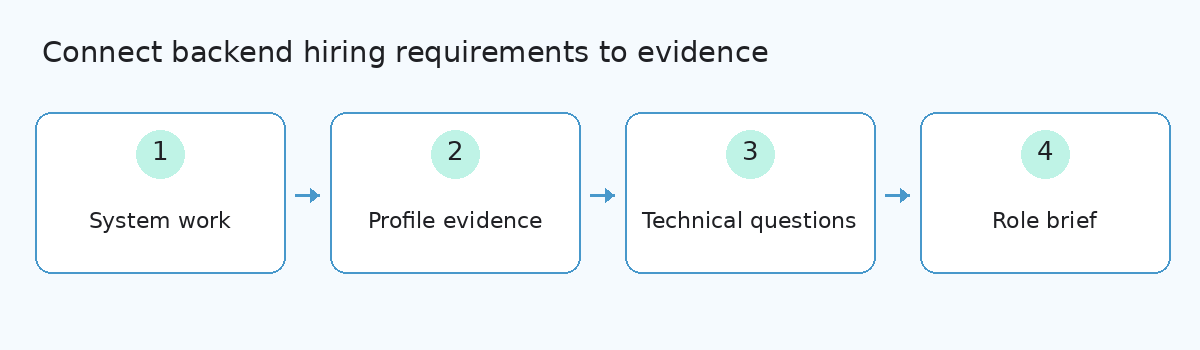
Turn the Vacancy into Observable Evidence
Replace broad labels such as senior developer with specific responsibilities. Will the person own database migrations, investigate production incidents, or design an API used by other teams? Decide which responsibilities need previous evidence and which the team can teach. Record the answer in language a recruiter can apply.
Tools for automated talent sourcing can help search professional profiles and organize contact research. Use the vacancy brief to review the results. A record containing Python and PostgreSQL may deserve a closer look, but those terms do not establish production responsibility. Keep the reason for inclusion with the profile.
For a role involving payments, relevant evidence might include retry handling, duplicate transaction prevention, or recovery after a failed operation. A profile describing website maintenance could involve different work. Ask the manager for examples that distinguish the two before relying on job titles or employer names.
Search Beyond One Title or Employer Group
Backend engineer, software engineer, platform engineer, and application developer can describe overlapping work. Search title alternatives alongside the responsibilities that matter. Include adjacent sectors when the engineering problems are comparable. A logistics platform and a subscription business may both need engineers familiar with asynchronous processing.
Review a small sample from each search before collecting more profiles. If results are dominated by frontend work, change the terms. If suitable people describe their work differently, add those phrases. Record which searches produce candidates with evidence tied to the brief so another recruiter can repeat the work.
- List title alternatives used by the target employers.
- Pair each required responsibility with a screening question.
- Distinguish language familiarity from operating a production system.
- Keep missing evidence as a question for the candidate.
Separate Sourcing from Technical Assessment
The recruitment process recruitment process includes several decisions after the first profile search. A recruiter can check employment, role scope, and the presence of relevant work. The engineering team should assess technical claims through a consistent interview or work discussion. Avoid turning a keyword count into an unofficial technical score.
A public repository can help a reviewer understand code the candidate has chosen to share. An empty public profile provides little evidence either way. Many engineers work on private systems, and some cannot publish client code. Offer candidates another way to describe their contributions, such as an anonymized design discussion.
Ask what the person owned, what constraints applied, and what changed after their work. An engineer might have contributed one endpoint to a large service or owned its operational behavior. Both can be useful backgrounds, but they should lead to different interview questions.
Build a Screening Record the Hiring Manager Can Use
Keep the current role, relevant project evidence, source date, and unresolved questions in the same record. Describe the candidate's contribution accurately. A phrase such as worked with Kubernetes may mean using an existing deployment setup or maintaining cluster infrastructure. Record the ambiguity instead of assigning a level yourself.
For example, a candidate's profile may mention moving a reporting job to a queue. A useful note identifies the queue technology and the stated responsibility. The interview can then examine failure handling, duplicate processing, and monitoring. This gives the manager a starting point without claiming those topics have already been assessed.
Check the Person Before Finding a Contact Channel
Confirm the person's current employer and role using a recent professional source. Profiles and company directories can disagree after a move. Mark uncertain records for review, and avoid referring to a current team until you have checked it. Keep professional contact research separate from the assessment notes.
Use the organization's approved recruiting channels and respect communication preferences. A contact finder may return an address, but the recruiter still needs a relevant reason for approaching the person. Retain only the information needed for recruiting, and keep records in the approved system with suitable access controls.
- Agree on the role's actual engineering responsibilities.
- Review a small set of profiles against those responsibilities.
- Record evidence, uncertainty, and questions for the technical interview.
- Confirm employment and the intended contact channel.
- Send a specific role brief and assign replies to a recruiter.
| Profile Claim | What Remains Unknown | Question |
|---|---|---|
| API development | Ownership and consumers | Who used the API? |
| Queue processing | Failure handling | How were retries handled? |
| Database work | Production responsibility | Who planned the migration? |
Explain the Engineering Work in the First Message
Tell the candidate what the team is building, which responsibilities the role carries, and how the working arrangement operates. Refer to a checked part of their background. Avoid claiming a perfect match or inventing details about projects. A candidate needs enough information to decide whether the role merits a conversation.
After the first interviews, compare the sourcing notes with the engineering team's findings. Revise searches that repeatedly surface the wrong scope of work. Before opening the next search, agree with the manager on one concrete change to the evidence you are looking for.