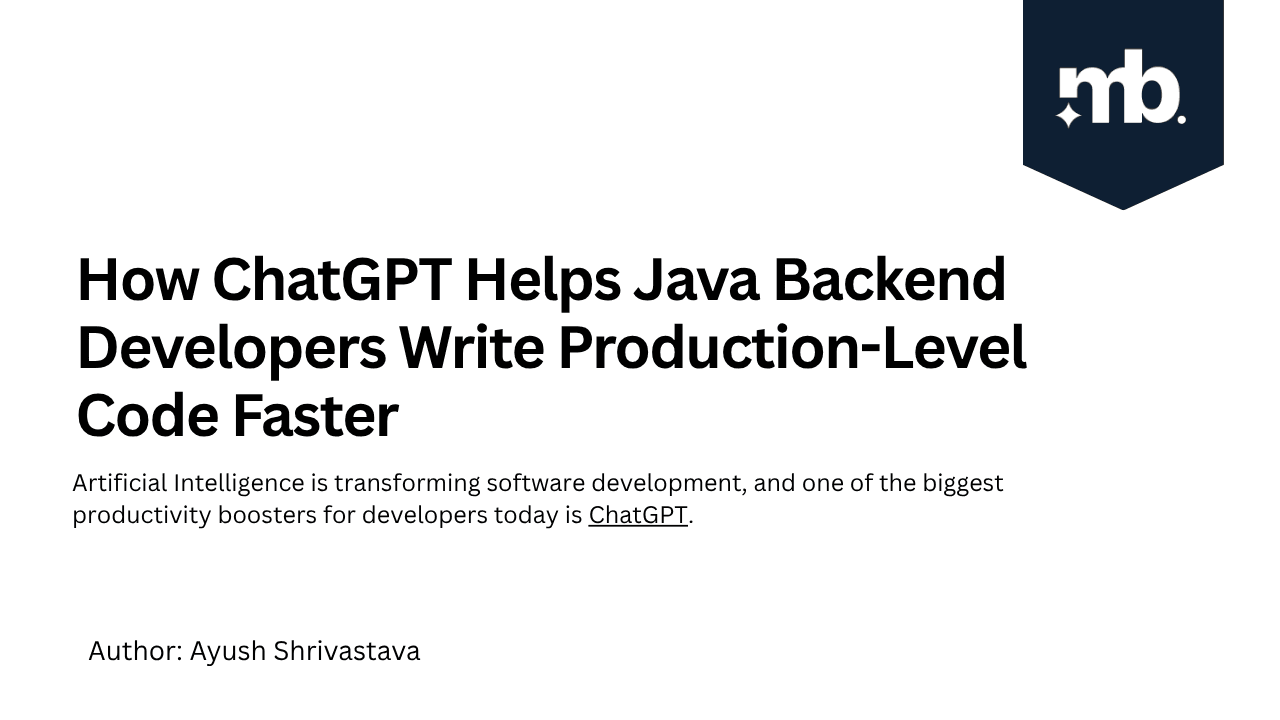
Artificial Intelligence is transforming software development, and one of the biggest productivity boosters for developers today is ChatGPT.
For Java backend developers, ChatGPT acts like a virtual coding assistant that helps generate code, debug applications, optimize APIs, improve architecture, write documentation, and accelerate development speed.
Modern backend development is no longer limited to writing simple CRUD APIs. Developers now work with:
Spring Boot
Microservices
Cloud Deployments
Kafka
Redis
PostgreSQL
Docker
Kubernetes
AI Integrations
Security Layers
Payment Systems
Scalable Architectures
Managing all these technologies together requires deep expertise and significant development time. ChatGPT helps reduce this complexity and increases productivity by automating repetitive tasks and assisting with production-level engineering practices.
Why Java Backend Developers Should Use ChatGPT
Java backend developers spend a huge amount of time on:
Writing boilerplate code
Reading documentation
Debugging issues
Fixing configuration problems
Searching Stack Overflow
Writing SQL queries
Creating APIs
Generating DTOs and entities
Configuring security
Writing tests
Instead of manually doing everything, developers can use ChatGPT to instantly generate optimized solutions.
This allows developers to:
Deliver projects faster
Improve code quality
Learn advanced concepts quickly
Reduce development stress
Increase productivity dramatically
Generate Production-Ready Spring Boot APIs
One of the biggest advantages of ChatGPT is rapid backend API generation.
A Java backend developer can instantly generate:
Controller classes
Service layers
Repository layers
DTOs
Entity classes
Validation logic
Pagination
Sorting
Swagger documentation
Global exception handling
Example Prompt
Create a production-ready Spring Boot REST API for employee management using Java 21, MySQL, JPA, Lombok, validation, pagination, logging, Swagger, and global exception handling.Real-World Example
Suppose a startup is building an HR Management System.
Normally, developers may spend:
3–4 hours setting up project structure
2 hours writing entities and repositories
2 hours implementing exception handling
1 hour configuring Swagger
Using ChatGPT, most of this setup can be generated within minutes.
Helps Developers Write Cleaner Architecture
Production-level systems require clean architecture and maintainable code.
ChatGPT can help developers:
Apply SOLID principles
Use design patterns
Create a layered architecture
Implement dependency injection correctly
Follow clean coding standards
Improve readability
Example Prompt
Review this Spring Boot service class and refactor it using SOLID principles and clean architecture.Benefits
This is especially useful for:
Junior developers
Freelancers
Startup engineers
Developers preparing for interviews
It also helps teams maintain consistent coding standards.
Faster Debugging and Error Resolution
Backend developers regularly face complex issues like:
LazyInitializationException
Bean creation errors
Circular dependency problems
JWT authentication failures
SQL syntax issues
Redis cache problems
Docker networking issues
Kafka consumer failures
Instead of spending hours searching documentation, developers can directly ask ChatGPT.
Example Prompt
Explain why LazyInitializationException occurs in Hibernate and provide production-level solutions with examples.An e-commerce platform using Spring Boot and Hibernate may face slow database queries, entity mapping problems, and transaction rollback failures
ChatGPT will help explain the issue and provide optimized solutions quickly. This significantly reduces debugging time.
API Integrations Become Much Easier
Modern backend systems integrate with many third-party services.
Examples include:
Payment gateways
CRMs
SMS services
Email providers
Cloud storage
AI APIs
ChatGPT can generate:
Integration code
Authentication flow
Webhook handlers
Retry mechanisms
Error handling logic
Example Prompt
Generate a complete Razorpay payment integration in Spring Boot with payment verification, webhook handling, and database persistence.A SaaS platform integrating Razorpay, Stripe, Zoho, and Twilio can save days of development effort.
Database Design and Query Optimization
Backend developers spend a lot of time writing SQL queries and optimizing database performance.
ChatGPT helps with:
SQL query generation
PostgreSQL optimization
Indexing strategies
Pagination queries
Native queries
JPA relationships
Database schema design
Example Prompt
Write an optimized PostgreSQL query for fetching the latest orders with customer details using indexing and pagination.For an analytics dashboard handling millions of records, optimized queries can reduce API response time from 8 seconds to less than 500 milliseconds.
Microservices Development Support
Microservices architecture is now common in enterprise systems.
ChatGPT helps developers create:
API Gateway setup
Eureka service discovery
Kafka messaging
Config server
Circuit breaker
Docker containers
Kubernetes deployment files
Example Prompt
Create a scalable microservices architecture using Spring Boot, Eureka, Kafka, Redis, PostgreSQL, API Gateway, and Docker.Benefits
This helps developers:
Learn distributed systems faster
Reduce configuration errors
Build scalable systems quickly
DevOps and Deployment Assistance
ChatGPT also helps with deployment and infrastructure tasks.
It can generate:
Dockerfiles
Docker Compose setup
Kubernetes YAML
CI/CD pipelines
GitHub Actions workflows
NGINX configurations
Example Prompt
Generate a production-ready Docker Compose setup for Spring Boot, PostgreSQL, Redis, and Kafka.This is extremely useful for full-stack backend engineers and startups.
Security Implementation Support
Security is critical in production systems.
ChatGPT helps implement:
JWT authentication
OAuth2 login
Role-based access
API security
Password encryption
Refresh tokens
Session management
Example Prompt
Create a Spring Security JWT authentication system with refresh tokens and role-based authorization.Unit Testing and Automation
Testing is often ignored due to time pressure.
ChatGPT can generate:
JUnit tests
Mockito tests
Integration tests
API test cases
Mock services
Example Prompt
Generate JUnit and Mockito test cases for a Spring Boot UserService class.This improves code reliability and reduces production bugs.
Technical Documentation and Blogging
Developers often struggle to write:
README files
API documentation
Architecture documents
Technical blogs
ChatGPT can generate professional documentation instantly, which improves:
Team onboarding
Collaboration
Open-source contributions
Personal branding
Real Productivity Benefits of ChatGPT
Using ChatGPT can help Java backend developers:
Task | Manual Time | With ChatGPT |
|---|---|---|
CRUD API Setup | 3 Hours | 20 Minutes |
JWT Authentication | 5 Hours | 45 Minutes |
Docker Setup | 2 Hours | 15 Minutes |
SQL Optimization | 4 Hours | 30 Minutes |
Debugging Errors | Several Hours | Minutes |
Writing Documentation | 2 Hours | 15 Minutes |
This productivity boost allows developers to focus more on business logic and innovation.
30 Powerful ChatGPT Prompts for Java Backend Developers
Spring Boot Prompts
Create a production-ready Spring Boot CRUD API using Java 21 and MySQL.
Generate a layered architecture for a Spring Boot application.
Create pagination and sorting APIs using Spring Data JPA.
Build global exception handling for Spring Boot.
Generate DTO mapping using MapStruct.
Security Prompts
Create JWT authentication with refresh token support.
Implement role-based authorization in Spring Security.
Generate an OAuth2 Google login integration.
Build API rate limiting using Redis.
Explain CSRF and CORS with Spring Security examples.
Database Prompts
Optimize this PostgreSQL query for performance.
Generate an indexing strategy for large-scale databases.
Create JPA entity relationships with examples.
Explain lazy vs eager loading in Hibernate.
Generate Flyway migration scripts.
Microservices Prompts
Create a Spring Cloud microservices architecture.
Generate Eureka Server configuration.
Build Kafka producer and consumer services.
Generate API Gateway setup.
Create a distributed logging setup using the ELK stack.
DevOps Prompts
Generate Docker Compose for Spring Boot and PostgreSQL.
Create Kubernetes deployment YAML files.
Build GitHub Actions CI/CD pipeline.
Generate NGINX reverse proxy configuration.
Explain the blue-green deployment strategy.
Advanced Backend Prompts
Create a WebSocket real-time notification system.
Build a Redis caching layer in Spring Boot.
Generate scalable notification service architecture.
Create an AI chatbot integration using Spring AI.
Review and optimize this backend architecture for scalability.
Final Thoughts
ChatGPT is becoming an essential productivity tool for Java backend developers. It helps engineers:
Write code faster
Learn advanced concepts
Build scalable systems
Debug issues quickly
Improve architecture
Reduce repetitive work
Developers who learn how to use AI tools effectively will have a major advantage in modern software engineering. Whether you are building:
Enterprise applications
SaaS platforms
Fintech systems
AI products
Real estate platforms
E-commerce applications
ChatGPT can help accelerate development and improve code quality significantly.